 By Javier Martínez, Founder — Great Digital Experience | July 2026
What Spain’s 2026 Championship Teaches Us About Teamwork, Strategy, and Communicating Across Cultures
By Great Digital Experience (GDE) | Bilingual and Multicultural Brand Strategy
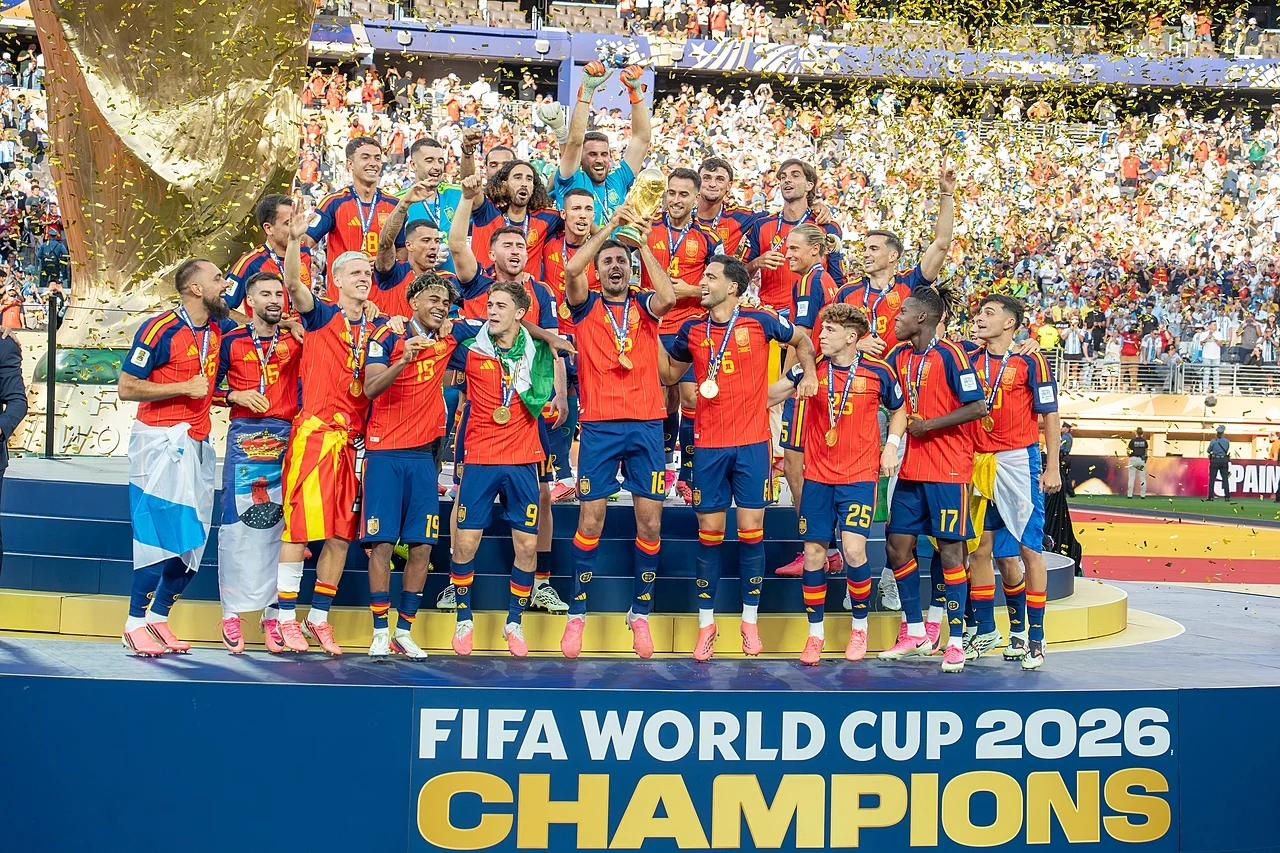
Yesterday in New Jersey, Spain lifted the FIFA World Cup trophy, defeating Argentina 1-0 in extra time to become the 2026 World Champions.
It was the kind of final that stays with you. Not because of a flurry of goals, but because of what it revealed about discipline, trust, and collective intelligence under pressure. Emiliano Martínez made 11 saves (the most ever recorded in a men’s World Cup final) and still lost, because Spain’s system was more powerful than any individual performance.
At GDE, we watch moments like this through a particular lens: not just as fans, but as multicultural brand strategists. And what we saw on that field is exactly what we build for our clients — every day, in every campaign, in every language.
Here are five lessons from the 2026 World Cup that go far beyond football.
1. Cohesion Outperforms Star Power
Spain didn’t win because they assembled the most famous names. They won because no name was bigger than the team.
Lamine Yamal, one of the most electrifying players in the world, played structured, disciplined football within the system. Pedri, a starter of extraordinary quality, was benched after the Round of 16 because the team’s tactical needs came first. Coach Luis de la Fuente built a squad around unselfishness and collective execution, and the result was a 38-match unbeaten run that now spans two major championships.
What this means for your brand: Campaigns built around a single “hero” message, a single channel, or a single cultural voice are fragile. They win when everything goes right and collapse when one element fails. Cohesive brand systems, where strategy, creative, language, and audience insight work together, are resilient. They perform across contexts, across platforms, and across communities.
There is no shortcut to that kind of alignment. But it’s the only kind that lasts.
2. Strategy Is a Language, and It Has to Be Shared
Spain conceded just one goal in the entire tournament; the first World Cup champion in history to win the title while allowing only a single goal. That didn’t happen by accident. It happened because every player understood not just their own role, but how it connected to every other role around them.
On the pitch, communication was constant, precise, and collective.
What this means for your brand: In multicultural marketing, the most common failure isn’t a lack of creativity. It’s a lack of shared strategic language. Marketing says one thing, communications says another, and the audience receives a fragmented message that doesn’t land in any language, let alone two.
Cohesive communication starts before the first asset is produced. It starts with a shared understanding of who you’re speaking to, what you’re saying, and why it matters to that specific community. Without that foundation, even the most beautiful creation falls short.
We don’t just build campaigns. We build the shared language first.
3. Culture Connects What Language Alone Cannot
The 2026 World Cup was more than a sporting competition. It was a 48-nation demonstration of what happens when human beings are given space to meet each other across differences.
Mexican fans welcomed South Korean supporters with open arms and open hearts, chanting “Coreano, hermano, ya eres mexicano” (“Korean brother, you are now Mexican”). Scotland and the city of Boston forged a real cultural and economic partnership over shared celebration. Cape Verde’s goalkeeper Vozinha became a global sensation overnight — not because of marketing, but because of authenticity. And when Lionel Messi walked off the field in tears, millions of people around the world cried with him; not because Argentina lost, but because they recognized something profoundly human.
What this means for your brand: This is what multicultural marketing is supposed to do at its best. Not translate. Not adapt. Connect.
Culture isn’t a demographic box to check. It’s the frequency at which people feel seen, understood, and respected. The brands that resonate with multicultural audiences aren’t the ones with the biggest budgets; they’re the ones that show up with genuine cultural intelligence, consistent presence, and a real point of view.
At GDE, we don’t approach bilingual marketing as a translation service. We approach it as a bicultural partnership. That distinction changes everything.
4. Trust Is a Competitive Advantage
When Ferran Torres scored in the 106th minute, he didn’t celebrate alone. Every player on the bench, every staff member was already running toward him. That wasn’t choreography. That was culture, the natural expression of a team that had built real trust over time.
38 consecutive matches without a loss across two major championships doesn’t happen by chance. It’s the product of consistent investment in relationships, communication, and shared accountability.
What this means for your brand: Your clients feel the difference between a team that trusts each other and a team that doesn’t. So does your audience. The internal culture of an organization radiates outward, through tone, creative energy, responsiveness, and the quality of ideas that make it into the room.
You cannot manufacture an authentic external connection when it doesn’t exist internally. Build trust first. The results follow.
For organizations working across cultures and communities, this is especially true. Multicultural audiences can sense inauthenticity immediately. A brand that hasn’t done the internal work — that hasn’t genuinely integrated cultural intelligence into its strategy — will always feel like it’s performing diversity rather than practicing it.
5. Inclusion Is Architecture, Not Decoration
For the first time, 48 nations competed in a single World Cup, and the result was the most-watched sporting event in recent memory, with individual matches drawing over 50 million viewers in the United States alone. The host nations (the United States, Mexico, and Canada) created a tri-national stage where three distinct cultures had to collaborate to produce one unified tournament.
And they did. Seamlessly.
Countries from Africa, Asia, the Caribbean, and Central America made deep runs. New stories emerged from every corner of the globe. The tournament’s expanded format wasn’t just a logistical decision; it was a structural statement about whose stories belong on the world’s largest stage.
What this means for your brand: Multicultural audiences are not a niche. They are the architecture of the modern market. In the United States alone, there are 67 million Spanish speakers. Across North America, the demographics of who watches, who buys, and who advocates for brands are shifting in ways that make cultural plurality not a secondary consideration — but a primary strategic imperative.
The 2026 World Cup proved, at a planetary scale, that the most inclusive frameworks generate the most reach, the most resonance, and the most revenue. That’s not an argument for doing the right thing. It’s an argument for doing the smart thing — which, in this case, happens to be the same.
What Spain Lifted Was More Than a Trophy
They lifted proof that collective intelligence, strategic clarity, cultural fluency, and human trust, when synchronized, can beat any combination of individual stars in the world.
That’s what we build at Great Digital Experience.
Not just campaigns. Not just content. The internal alignment, the shared strategic language, and the cultural cohesion that make everything else work across communities, across platforms, and across languages.
The World Cup is over. The lesson is permanent.
Ready to build something cohesive? GDE is a boutique bilingual branding and multicultural marketing agency based in Altadena, CA. We help organizations communicate with clarity, cultural intelligence, and purpose — in English, in Spanish, and in the spaces where both meet.
Contact us · Learn more about GDE · Follow us on LinkedIn
#MulticulturalMarketing #BilingualBranding #BrandStrategy #WorldCup2026 #CulturalIntelligence #GDE #GreatDigitalExperience #CohesiveLeadership #MktLatino